
Sunshade louvres, also known as sun control devices or sun screens, are designed to reduce the amount of direct sunlight that enters a building, while still allowing natural light in. These louvres consist of a series of horizontal slats that can be fixed or adjustable to any angle on the facade of a building or installed above windows or doors.
Our sunshade louvres follow the passive-design recommendations of the Australian Government’s YourHome guide, helping to block unwanted summer sun, maintain indoor comfort, and reduce cooling energy costs.
ADA Louvres designs and manufactures high-quality sunshade louvre systems in Australia, providing effective solar control, glare reduction, and architectural screening for commercial and residential projects.
Our range of aluminium sunshade louvres is engineered to reduce heat gain while maintaining natural light and outward visibility, making them ideal for modern façade design, sun hoods, and screening applications.
All systems are custom-made in Adelaide using premium materials and tailored to suit your project requirements.

The Modbury Series is a compact, panelised aluminium sun-louvre system designed for applications where a slim profile and clean sightlines are essential. Its reduced overall depth allows it to integrate seamlessly into façades while still providing effective shading performance.
Blades are mounted on a central tie-rod with consistent spacing and set to an optimal shading angle, delivering a neat, uniform appearance with low maintenance and long-term durability.
At a glance
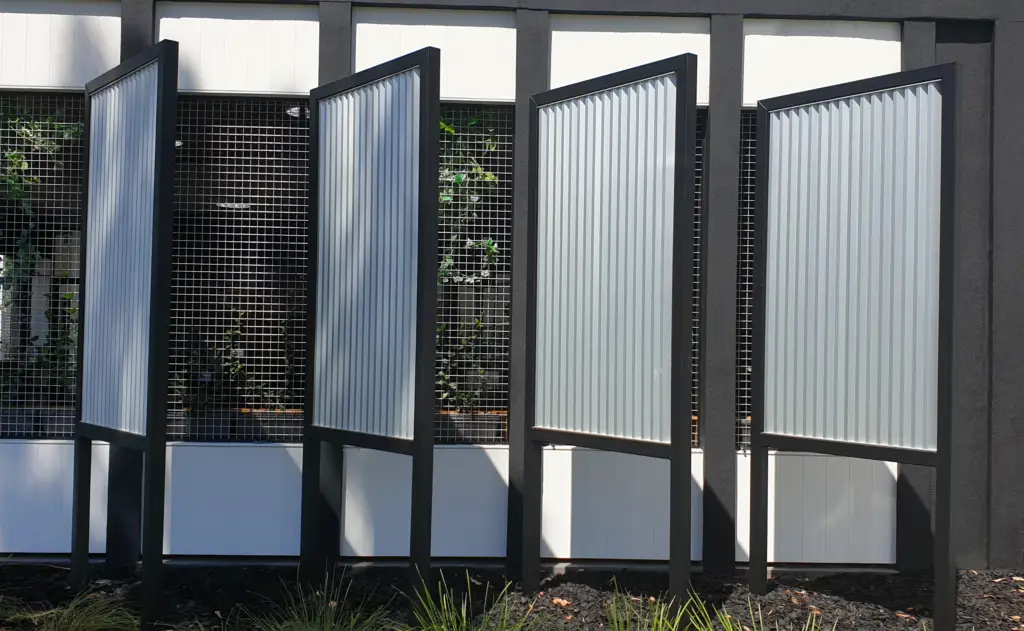
The Crew Series is a panelised aluminium sunshade system designed for both horizontal sun hoods and vertical façade screens. With a wider blade spacing than the Modbury Series, it provides a strong balance between shading performance and visual openness.
Blades are mounted on a central tie-rod with precision spacers to maintain a consistent pitch and angle, resulting in a clean, repeatable architectural finish with efficient installation.
At a glance
Blade pitch: 60 mm
System type: Panelised aluminium sunshade louvre
Construction: 6063-T5 aluminium blades with central tie-rod system and spacers
Finishes:
Aluminium: Mill finish, natural anodised, coloured anodised, or powder coated
Options: Horizontal or vertical blade orientation, custom panel sizing
Typical applications: Sun hoods, façade screening, commercial buildings, architectural features, shading systems


The ELV150 is an architectural sunshade louvre system featuring a deep elliptical aerofoil blade designed to deliver high-performance shading while maintaining outward views and daylight. Its aerodynamic profile reduces glare and solar heat gain, making it ideal for projects requiring both performance and strong architectural impact.
The system can be installed horizontally or vertically and mounted using frames or bracket systems, allowing flexibility to suit a wide range of façade designs.
At a glance
Blade depth: 150 mm elliptical profile
Blade pitch: ~85 mm (typical)
Free open area: ~40% nominal
Construction: 6063-T5 extruded aluminium aerofoil blades with concealed fixing options
Finishes:
Aluminium: Mill finish, natural anodised, coloured anodised, or powder coated
Options: Horizontal or vertical orientation, bracket or framed systems, custom spacing and angles
Typical applications: Commercial façades, architectural shading, high-performance sun control, building envelopes, feature screens
All ADA sunshade louvres are manufactured from high-quality Australian aluminium (6063-T5) with corrosion-resistant properties for long service life.
Available finishes:
Mill finish
Natural anodised
Powder-coated (full colour range)
Coloured anodised
ADA sunshade louvres are designed to enhance building performance by:
Reducing solar heat gain
Minimising glare
Maintaining natural daylight
Preserving outward visibility
Enhancing façade aesthetics
Blade spacing, angle, and configuration can be tailored to suit orientation, façade design, and shading requirements.
Sun hoods
Commercial façades
Window shading systems
Architectural screening
Residential developments
Building envelopes